The American view of China
Chinese Fashion and the “Mao Suit”
As tensions began to cool, with the Korean conflict fading into historical memory, the public sentiment around communism would also begin to gradually shift. With the Second Red Scare and the nation-wide witch hunt of McCarthyism effectively over, many socialist and left-wing groups would begin showing more of an active presence within American society, groups like the Students for a Democratic Society, the Socialist Workers Party, and others like the Black Panthers.
The official logo of the Socialist Party of America.
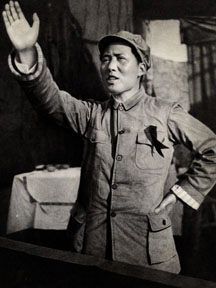
A photo showing a young Mao Zedong wearing his suit, circa 1939.
With greater social acceptance, there was now a chance to have a much larger physical presence within American society. As a result, one of the choices that many members of the left-wing American groups would choose to wear the “Mao Suit” as a way of signaling their ideology as part of a broader anti-establishment movement. The Mao Suit itself was actually a much older piece of clothing that originated in the creation of the Republic of China back in 1912. Leaders of the Republic were largely dissatisfied with the prior Qing dynasty’s failure to develop and modernize China, and thus adopted their own formal tunic which was based off of Western European military tunics, but with a unique Chinese style. This was originally titled the “Zhongshan Suit”, but would come to also be known as the “Sun Yat-sen Suit”, named after the Republic’s leader. These suits would often be worn by many officials of Communist China, including Mao Zedong himself who had a particular fondness of its style, thus earning it the new moniker of “Mao Suit”.
Mao’s Little Red Book In Western Hands
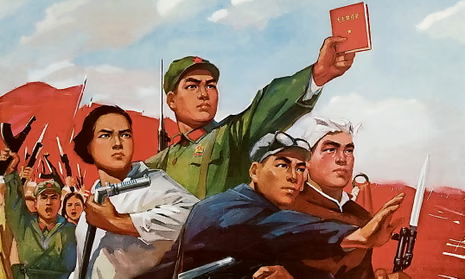
A propoganda poster depicting members of the Red Guards and People’s Liberation Army with the Little Red Book.
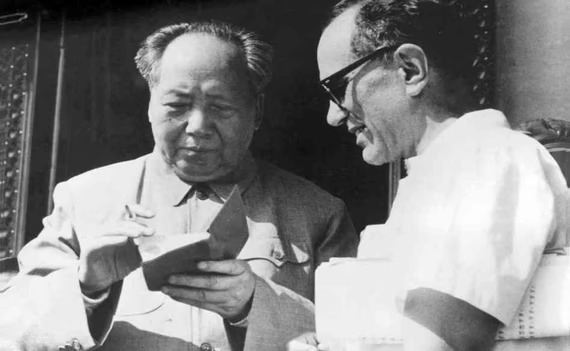
Sidney Rittenberg, the second American to achieve citizenship in Communist China and close associate of Mao, has his copy of the Little Red Book personally signed.
A major point of reform in China by Mao Zedong was that of a revolution in the very culture of China itself. In 1966, a book called “Quotations from Chairman Mao Tse-tung” would be published, and would come to be known as “Mao’s Little Red Book”. Part officials were encouraged to keep a copy with them, and owning one was practically a universal requirement for any kind of membership with any kind of official group. With the book’s initial arrival in America, it would actually see a fair amount of interest by the previously mentioned left-wing groups of the American public. Of course, it would also see a fair amount of ridicule by anyone who had any grudge against communist sentiment, but this was to be expected. Huey Newton, one of the founders of the Black Panthers, held Mao in high regard, and would sometimes sell copies for fund-raising.
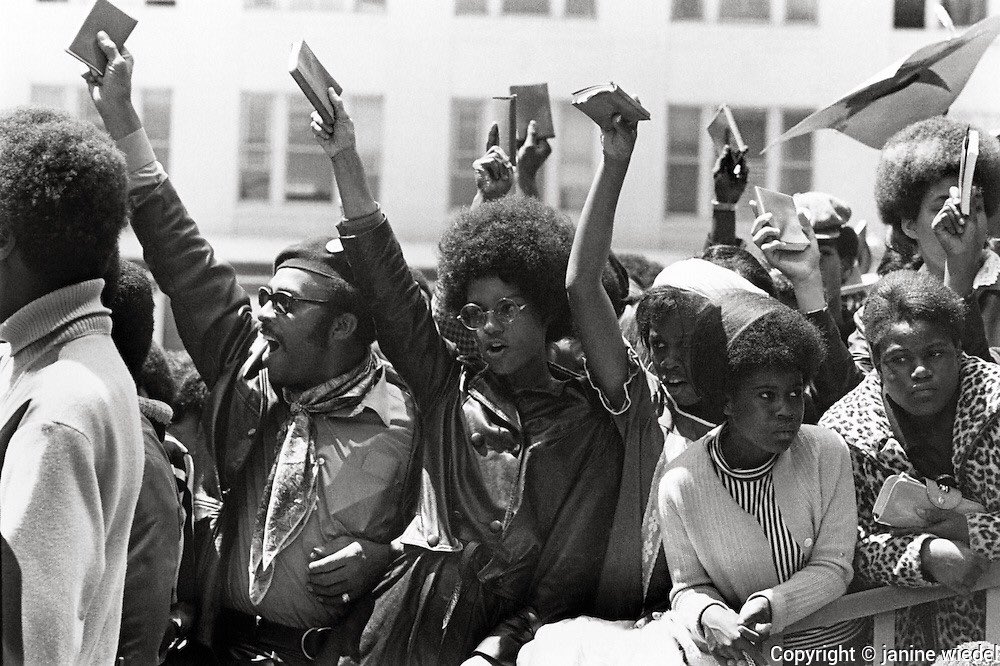
Members of the Black Panthers raising their copy of the Little Red Book in protest to free Huey Newton.
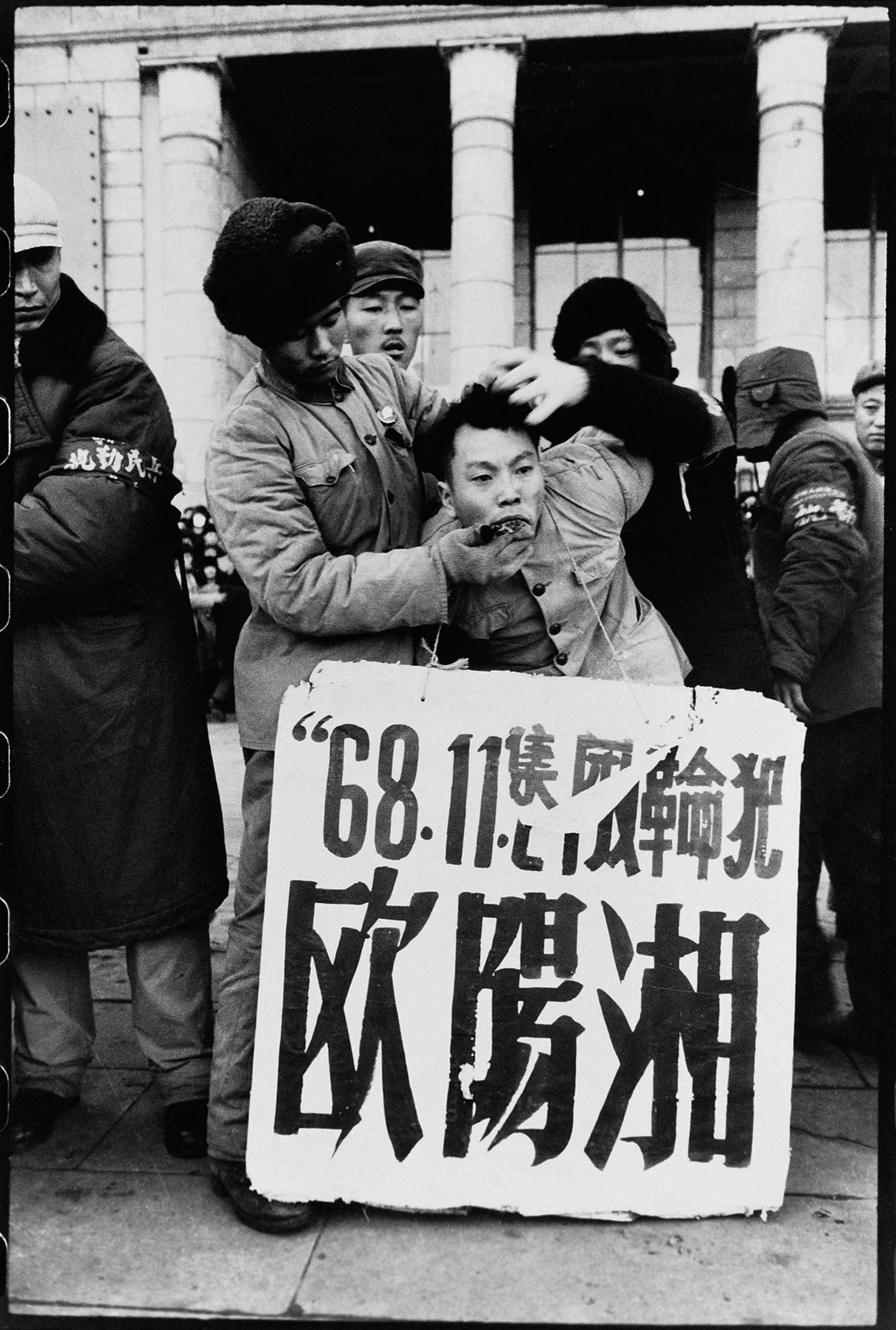
The son of a purged official endures a Struggle Session, the sign details the crime of the boy publically defending his father and the date of the offense.
The narrative would take a large shift in the early 1970s however, as over in China the Cultural revolution was in full swing. Many young men and teenage boys would be a part of a group of organizations known as the “Red Guards”, which were various student-led paramilitary groups that would seek destroy the “Four Olds” of Chinese society: Old culture, old ideas, old customs, and old habits. The philosophy of Mao’s Red Book was the prime catalyst in these actions, and the subsequent damage it caused. This often meant the complete destruction of historical artifacts and architecture, as well as the targeting of intellectuals, officials, and teachers, these people sometimes being their own parents. These people could expect to face brutal acts of public humiliation, particularly in the infamous “Struggle Sessions” where an individual would be forcibly donned with a dunce cap and a sign detailing their “crimes”, before being frog-marched out in front of mass rallies and forced to kneel on their hands and knees. These were usually meant as psychological degredation, but could often escalate to violence, with the victim being tortured or even killed, although suicide could also be expected for those who “survived”.
As these events became better understood in the United States, and as China exited the time of the Cultural Revolution, popularity in the Little Red Book began to decline. Any mainstream popularity the book had early on had practically vanished by the end of the 1970s, with president Richard Nixon’s visit to China in 1972 beginning a normalization in diplomatic relations with China that would gradually mellow out tensions between the two nations, leaving any anti-imperialist or anti-establishment sentiment in the book reduntant by 1979.
The Tiananmen Square Incident
In the capital of Beijing, a student protest would begin on the 15th of April, and would continue for almost three months. The protestors would largely coalesce in the Tiananmen Square and the surrounding streets and thoroughfares, having been called to action by the death of Hu Yaobang, a pro-reform general secretary of the Communist Chinese Party. These student protesters would make their stand as advocates for democracy in China, not wishing to up-end the system itself, as many were ardent supporters of Chinese communism, but advocates of liberty nonetheless. On April 4th, the gathered police and local army units would begin cracking down on the protest, making arrests wherever possible and dispersing the crowd, and by the end of the day anywhere from a few hundred to a few thousand people were left dead by in the wake of the violent chaos.
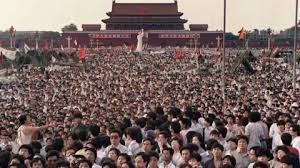
Protestors gathered in the square in front of the Tiananmen building of which the town square was named after.
With plenty of notice to get their own eyes on the event, many elements of the world’s news organizations were able to witness firsthand the massacre that ensued. Citizens in the United States were left shocked and horrified at the news, with nothing short of total condemnation falling in shortly after. Then-president George Bush would heavily scrutinize the disaster and impse heavy sanctions onto China, and approval ratings of China among the general public would collapse, dropping from 74% before the incident to only 34% following it. A report of the time gives a sobering view of the event from a Western perspective, stating that while truly awful and that the people of America fully support the liberty of Chinese citizens, these affairs were something that the government and people of China must contend with.1 Many decried actions of the Chinese government, but truly there was very little anyone could realistically do about it.
However, the United States government would be quick to capitalize on this diplomatically, show support to Chinese migrants by giving both immigrants and students citizenship if they were present in American between the time of the incident and April 11th the next year. A retrospective analysis of the event shows that it was clear that any attempt by the Chinese communications authorities to suppress or otherwise cover up the incident had completely failed, with multiple Western news agencies reporting on how the incident was very much going to be in the minds of its citizens, and even government officials had very little in the way of support of what had happened.2
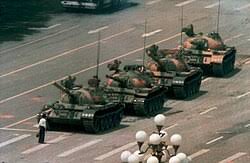
The famous image, captured by newscrew of Newsweek just after noon on June 5th, 1989.
But most impactful of all to the Western audience was the actions of a single unknown individual. On the 5th of April, with the square effectively secured, military forces would begin attempting to clear out the surrounding area. One column of tanks of the 1st Armored Division attempts to leave the square, but halts for a singular protester standing in the middle of the road. This man would stand unmoving for a brief moment, even moving to block the crew’s efforts to move around him. He would soon be pulled away by a group of people, some believe them to be concerned citizens while others thought they were government agents. Regardless, who this exceptionally brave man was or what happened to him remained unknown to the public, and to honor his act was given the simple title of “Tank Man”.
The famous image, captured by newscrew of Newsweek just after noon on June 5th, 1989.
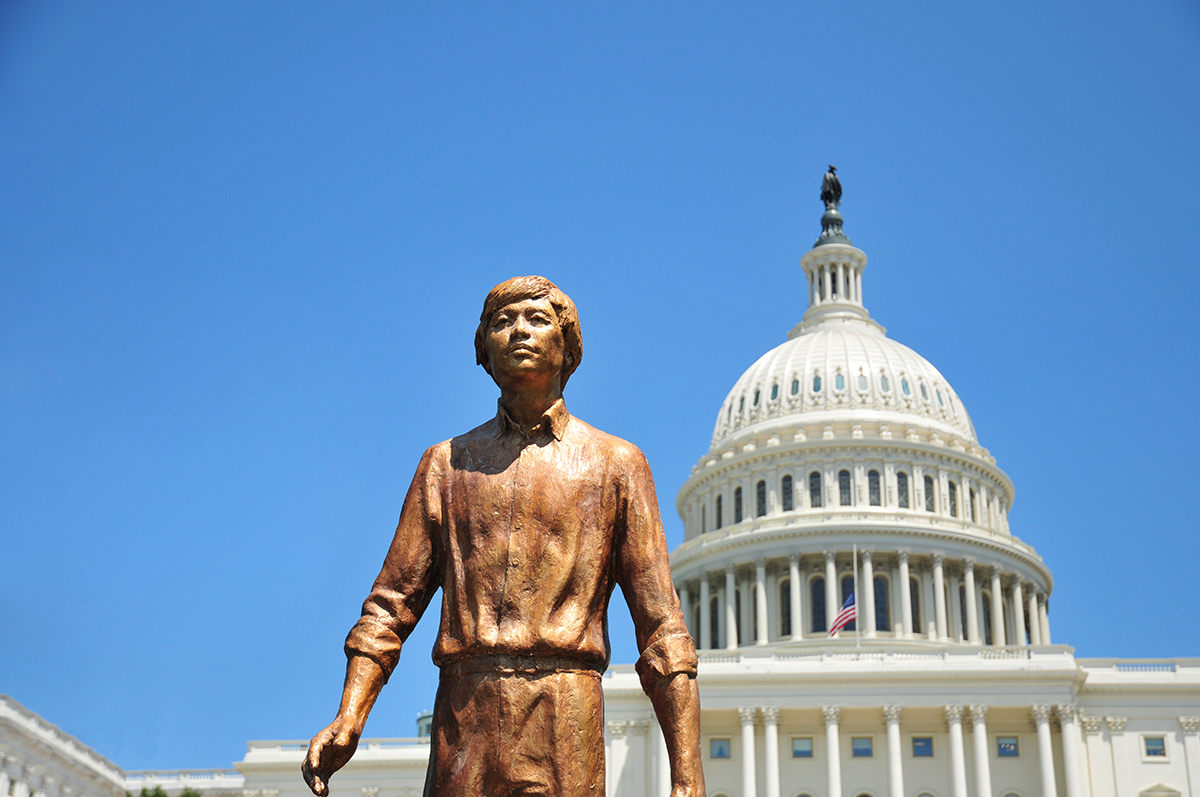
Even today, his image remains associated with defiance against tyranny and martial despotism, and would be forever immortalized in the pages of history with Time Magazine including him in a list of the top one-hundred most important people of the century. With countless references and parody depictions of this moment on the internet, the likeness of Tank Man stands strong within the world of Western social media, comparable in fame with images like the raising of the American flag on Iwo Jima, the moon landings, the fall of the Berlin Wall, and many others. On April 4th 2019, to commemorate thirty years since the Massacre at Tiananmen, a statue would be made of this individual, which today stands outside the White House as an eternal monument to his actions on that day.