The American view of China
Pre-Communist Influence
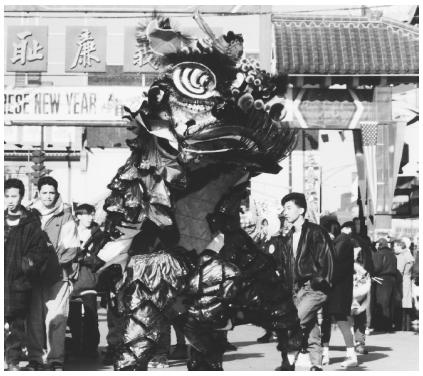
Chinese American performers carring a red and gold dragon while celebrating the Chinese New Year.
With regards to a lot of media depictions of China within America, one of the most important things to consider is that of China’s lengthy history and the culture thereof. People within the United States for a long time prior to the World Wars would have a certain fascination in China’s culture of the far-flung past, with figures like Benjamin Franklin and Thomas Jefferson having admiration of Confucian ideals of virtue and reward to personal merit. And such is the case with many American citizens as well, with a certain level of mystique dominating the mindset of many of those in the States, a rather cliché vision of a calm, calculating, exceedingly wise and esoteric figure.
The Chinese and other similarly Asian migrant groups would also have to contend with the view of the “Model Minority”. This was a view of the early-to-mid 1900s that still made a clear distinction between racial groups, but made the implication of Asians within American culture doing its due-dilligence to “properly assimilate” within the United States.[^source1] Combine that with elements of the “eastern exotic” with fancy imports of tea, silk, and porcelain, as well as more culturally impolite factors like the “Model Minority” and you get the overall view of “Oriental Mystery” that tends to be applied towards anything regarding South-East Asia behind the lens of American media.
In a rather paradoxical fashion, there would also be the stereotype of the “perpetual foreigner”, an idea that posits that, regardless of citizenship or birth nation, views Asian-Americans as this generalized other that can never fully assimilate into American society. With this is carried the assumption that any Asian-American could potentially hold stronger loyalties to their ancestral homeland rather than to the United States, potentially working as a foreign operative. It was this sort of idea that resulted in major civil upsets like the internment of Japanese-Americans with the outbreak of World War Two.
Historical Context & Beginning
In the wake of World War Two, the fractured warlord states of China would find themselves returning to conflict now that the threat of conquest by Imperial Japan was effectively nullified. Mao Zedong and the forces of the Communist Chinese warlord state in particular were eager to capitalize on the moment, as they had intentionally left the majority of the fighting against Japan to the Nationalists under Chiang Kai-shek. As a result, the now-exhausted forces of the Republic of China would be far less prepared and far less capable at effectively countering a follow-up attack by the communist forces.
With several major battles being lost and large swaths of territory being lost to communist forces, Chiang Kai-shek would make a final retreat to the island of Taiwan in December of 1949, moving the capital there alongisde anywhere from 1.5 to 2 million people, including civilians, soldiers, and government officials. With only small pockets of resistence left by nationalist forces, the Chinese Civil War was effectively over, leaving the communist faction under Mao as the de-facto rulers of the mainland.
Lingering Tensions
However, despite the nationalist forces essentially being forced out of China, the United States would remain at-odds with the new leaders. First and foremost, much like in Europe, the United States had supplied the Chinese People’s Republic largely as a means of being a thorn in the side of the Axis powers, but now that the war was over, this “enemy of my enemy” philosophy had largely fallen to pieces. It was seen that the next impending war would be between the ideologies of the Western democratized free markets and the Eastern state-centralized communism, and the United States was far from eager to add more countries to that list. In fact, many other nations in South-East Asia would see a large influx of attention from the United States in a movement described as an “all-out war of ideas, ideologies, propoganda, and subversion”.1
The United States would instead opt to continue cooperation with the nationalist government in-exile, providing their stronglhold of Taiwan protection by the forces of both the United States Airforce and Navy, primarily to discourage any further invasion attempts by the PRC. And to add further insult to injury, the seat representing China in the United Nations would continue to be occupied by diplomats of the in-exile Republc, remaining as such all the way into 1971 before Communist China was officially recognized as the new leaders.
A Golden Opportunity
Relations with China wouldn’t remain solely in the negative though. With the growing divide between China and Russia with the buildup of the impending Sino-Soviet split, many American politicians believed that they had the perfect opportunity to try and make diplomatic efforts appealing to China as a means of further politically and economically isolating the Soviet Union.
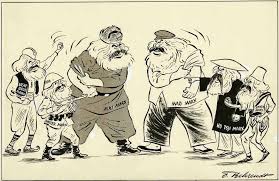
A political cartoon depicting the Sino-Soviet split, by Dutch artist Fritz Behrendt.
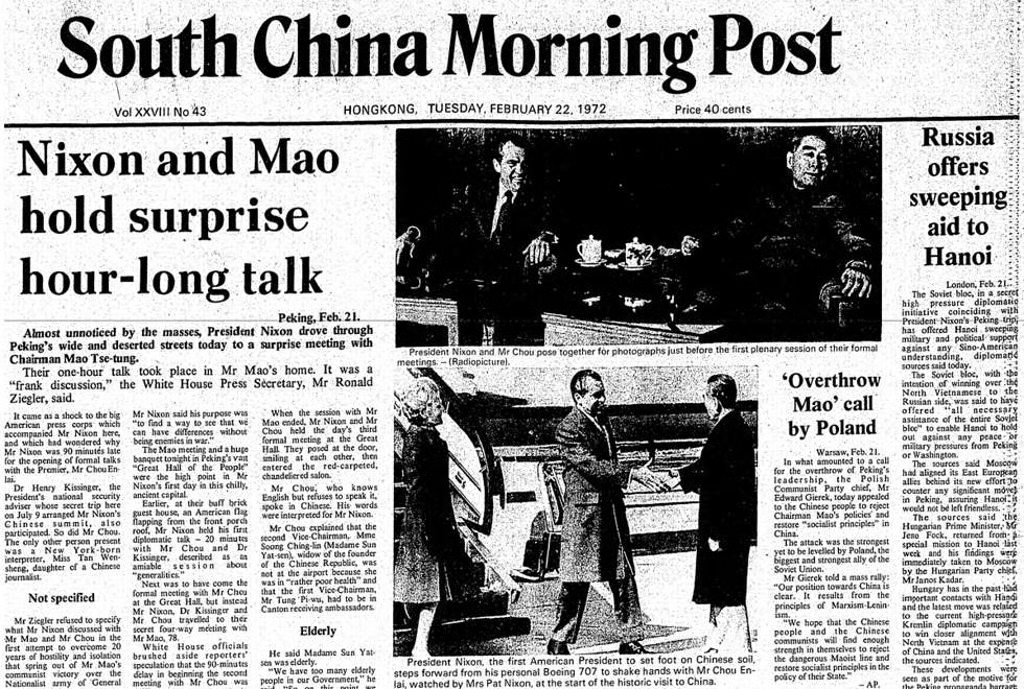
A news paper headline reporting on the diplomatic visit made by Richard Nixon to Mao Zedong in 1972.
This would result in multiple different diplomatic efforts, including the aforementioned inclusion of the PRC as the official representative of China in the United Nations. But There was also included events like president Richard Nixon’s visit to China, marking the first time a United States president.
Initial Perception
With these factors in mind, the early perception of Communist China and the broader “Oriental” sphere as a whole becomes a very fascinating area of the American public’s consciousness. Firstly and most prominently, there is a massive upswing in the amount of media depictions of South-East Asia within American theater and film. This is largely a consequence of American military presence becoming a much greater force in the region, with the end of World War Two’s Pacific theater, the occupation of Japan and its formerly-occupied lands, and the impending conflicts that would begin occurring not too long after the war’s end.
On the one hand, there was a great deal of fascination with these peculiar, fascinating foreign lands. Not just that, but it was part of the popular belief of the time both before and around World War Two that there existed something of a “special relationship” between China and America, since we had done so much for the various forms of China both during and before the civil war. This idea warped the general perception to some degree to imply that there couldn’t possibly be any reason for bad blood between China and the States.2
But on the other hand, many began to “face the music” about the whole ordeal as things began unfolding down in South-East Asia. They represented one of the single largest populations on the planet, and it seemed like pretty much the entire nation would fall in under the new regime with the guiding hand of the Soviets to move them along. While China was a very poorly industrialized nation, this would not prevent them from undergoing some major reforms in the industrial sector and striving towards it. By the time of the Korean war in 1950, China was now ready to make its first major move against the Western powers.