The American view of China
Prior to the War
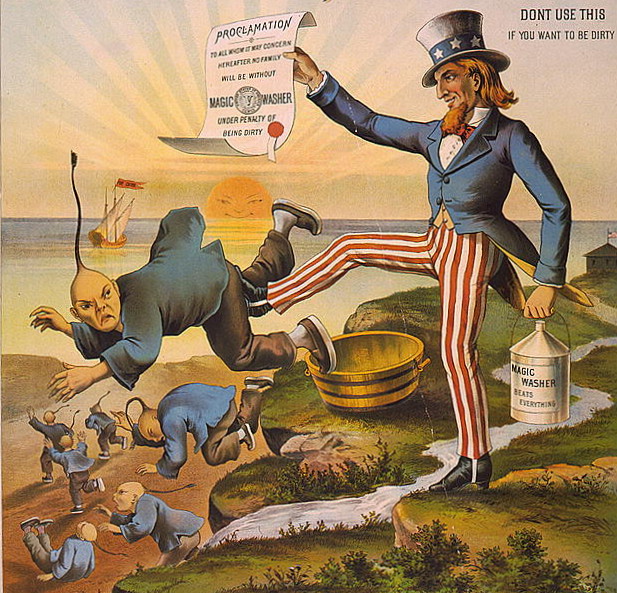
A propaganda poster depicting the American sentiment against Chinese immigrants at the time.
Prior to World War Two, dpeictions of people from China often weren’t the most glamorous, and were often deliberately offensive or otherwise rude in the sense that the American view of the people of China tended to refer to what is called the “yellow peril”. This stereotype smacked the people of South-East Asia, and particular to China, a depiction of the people being heathenous opium addicts, coming from a nation seen as weak due to the debacle of the Opium Wars. These depictions were extremely unflattering, largely rooted in a very strongly anti-immigrant opinion of the American public during the late 19th and early 20th century. Even in more “altruistic” depictions, it usually centered around Christian missionary work where it would make the Chinese out to be these poor, helpless, lost people who were given the “benevolence” of the American missionary efforts. Often times, it would kind of shake out as the American missionary groups actively “saving” the downtrodden people of China, once again, not doing much to help given that even the best case scenario tends to argue for them assuming a position of weakness.
A Change of Heart
But with involement in the fight against Japan, there would seem to be something of a turn-around in opinion regarding all of this. Instead of some lowly gremlin slinking around, or a helpless victim of a weak society, China in its fight against Japan would make it out to be an incredibly helpful ally to have in the fight, and would thusly have a turnaround in the disposition towards the people of China. As far as the depiction of this, however, it’s a bit more muddy than it may seem at first. There is obviously a high level of praise given to the Chinese partisan resistance members, being another group of “freedom fighters” standing up to the forces of the Axis, but there were a number of flaws in the depictions. One of the bigger ones is that it never really seemed to be able to leave behind the unnecessary racial profiles. One piece from around this time goes into heavy deliberation outlining the differences between someone from China compared to a figure like Tojo from japan, despite the two images showing people who look near-identical to one-another.1
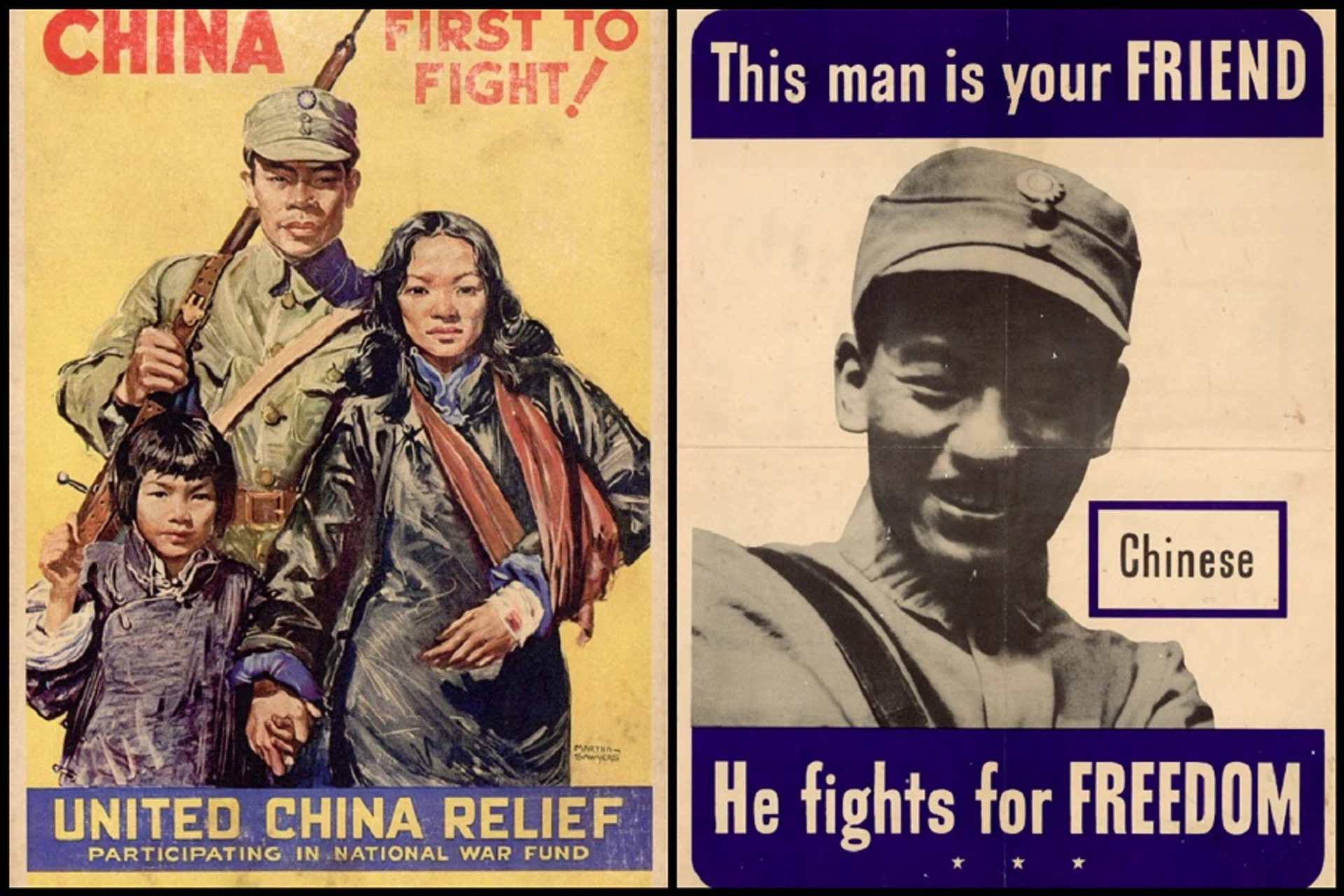
A couple wartime posters advocating for the Chinese fighting against Japan.
A further extension of this is that, for the more popular depictions including China in America’s periphery, a lot of it tends to focus on the “Flying Tigers” squadron, which was composed of a large number of American volunteer pilots. This kind of flie in the face of the whole point of inclusion, more or less just turning out as a moment of America bragging for itself while any real recognition for who they originally intended for praise goes unlcaimed.
Dissapointment and Korea Grudges
Unfortunately, this good standing wasn’t meant to last, as with the percieved incompetence of the Chinese Nationalists to adequately deal with the communist forces, that would lead to America being unable to do anything but watch as their former “great ally” was gradually crushed underneath the ideology of their new greatest enemy. And with diplomatic relations becoming worse ever day given the complete lack of diplomacy between Communist China and the United States, things would come to blows again. This time, however, was far more in-line with political propoganda that was directed towards the Soviets. But it doesn’t seem to have been a unanimous opinion even with this in mind. In fact, the thoughts seemed to persist that China wasn’t necessarily carrying this out under their own initiative, but rather that this was something that the Chinese were lead into doing by the Soviets. Despite everything faced up until now, there were still a good number of people in the public who chose to believe that the “real enemy” was still the USSR and that China didn’t really play a part in it.2
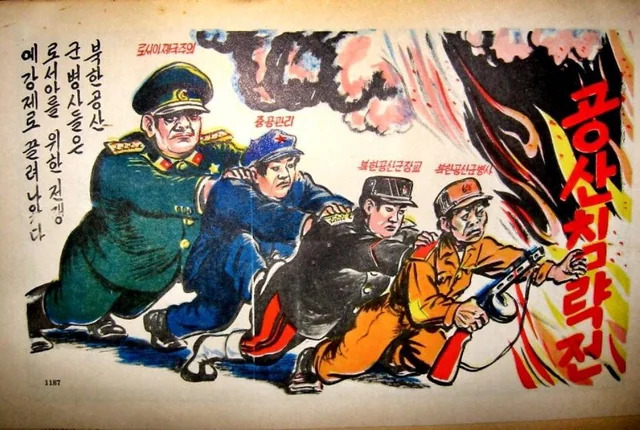
A South Korean propaganda poster claiming North Koreans are being used for the means of the Soviets.
But with the end of the Korean war, that would absolutely not mark the end of opinions held by those who fought. There were many sour and bitter opinions held by the American troops who ended up fighting in Korea. This likely emerges from the fact that this was the first time that Americans had gone up against their Cold War communist adversaries, which combined with a generally negative perception that was often lumped on with the Western view of the “oriental” world, resulted in a very strong, virtriolic hatred of the people. It’s around this time that the derogatory term of “gook” starts becoming a way of insulting the people of Asia, with American army and marine types often using it referring to their Chinese foes.
A likely image that comes to mind of many people regarding this is that of Clint Eastwood’s “Gran Torino”, particularly the Korean War vet’s high level of displeasure in getting involved with the locals that have moved in from South-East Asia and various other places.
A Complicated Image
All of this is to demonstrate that the American perspective on China and that of Eastern Asia as a whole is a very complicated affair. The perception seems to metronome back-&-forth between positive and negative from decade to decade, largely influenced by world affairs. This would largely set the tone for the views of China within American culture in the coming decades of the 1960s, ’70s, and ’80s.