Black Is Beautiful; The 60s to 70s
Black is Beautiful
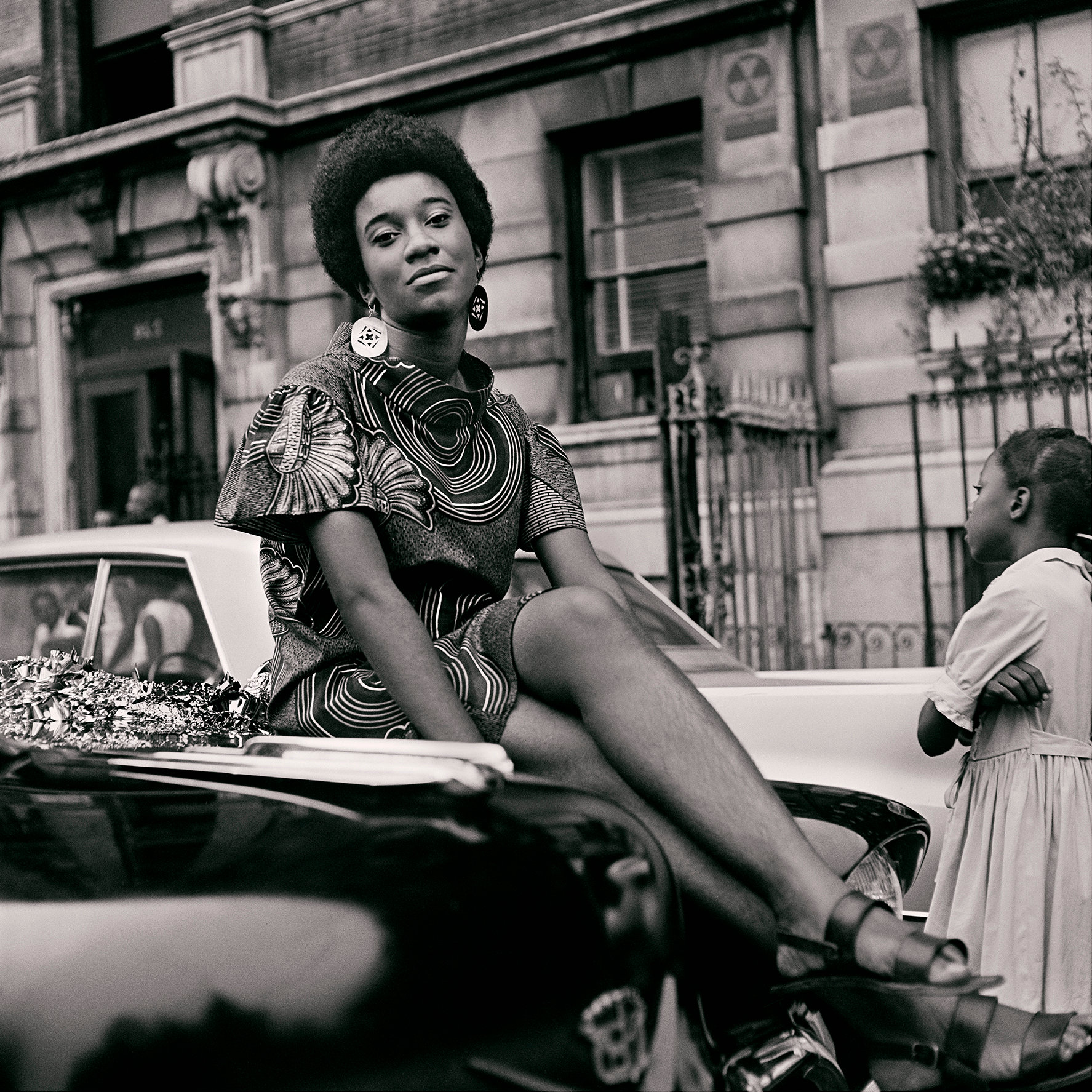
Untitled (Pat on Car), 1968. Credit… Kwame Brathwaite/Courtesy of Philip Martin Gallery, Los Angeles
Before the 1960s, most societal beauty standards for women centered on white women. However, with the Civil Rights movement also came outspoken Black people who proclaimed they were beautiful, too. That they didn’t need to straighten their hair or bleach their skin to be considered such, both things some individuals did before the Black is Beautiful movement. According to the article, ‘Making Black More Beautiful,’ the Black is Beautiful movement led to a temporary “decline… of the black hair-care industry,” [^source1] which largely centered around straightening curls to fit the Eurocentric beauty norms of the time period. Beyond the embrace of curls and coils, there was also an increase in cosmetic products specifically for Black women. Most of these cosmetics, however, were tailored towards light-skinned Black women. Regardless, magazines began to also shape their makeup tips around inclusivity. Redbook magazine put out an article describing what makeup Black women should use, and even praising Black skin, stating “Dark skin is a versatile background for make-up, and it affords a great opportunity for experimentation with color.” [^source2] A magazine that was aimed towards women of all races and marital statuses, giving tips for Black women specifically, was an important step in the right direction, though it seems small by today’s standards. Considering the article also mentions that there are “over 30 skin-tone variations” [^source3] for Black women when just a decade prior, only one makeup company catered towards dark-skinned Black women, this was monumental for the time. This makeup brand was specifically launched by a woman named Flori Roberts in 1965, and “was a step toward inclusion and Black consumers rejoiced.” [^source4]
Twiggy and Her Impact on Beauty
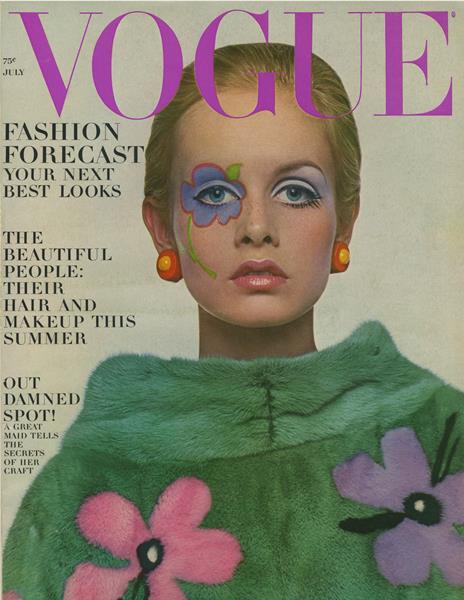
Twiggy on the cover of Vogue, 1967
With miniskirts or more boho-based fashion being all the rage amongst teen girls and young women, the cosmetic industry made sure not to fall behind. One of the most prominent examples of this was the makeup brand known for its lipsticks, Revlon. Revlon “ads act as a case study in adapting to the shifts of fashion and values by nimbly navigating their way through every look from high midcentury glamour to earthy hippie chic.” [^source5] Revlon made sure to target every subculture to attempt to capitalize on anything and everything. It worked out for them, as Revlon is still a major cosmetic brand today. While the early 60s style was to be sweet and innocent, encouraging young women to “paint a pretty portrait with makeup,” [^source6] color palettes were beginning to expand from pinks and reds. One prominent example of 60s beauty was a British model named Twiggy. Twiggy was called “the face of ‘66” in London, and in 1967, she appeared on the cover of Vogue magazine. Twiggy’s bold eye makeup, with drawn on lashes and bright colors, and her slim stature set a new standard for young women wanting to emulate magazines. Twiggy is considered the first supermodel by many, despite only actively working as a model for 4 years, and her image left it’s mark on the beauty standard of the world. Twiggy, herself has “been blamed… for pushing an aesthetic of extreme thinness,” [^source7] despite this being the fault of the modeling industry that actively makes that the goal. However, the trend for skinniness being beautiful was not going anywhere anytime soon.
Conclusion
Overall, the 1960s and 1970s were a time of great change. From the Civil Rights movements, to Woodstock and the Summer of Love, one thing that was consistent was the idea of experiementation. Civil Rights leaders experimenting with ways to fix our broken society. Youth experimenting with gender, sexuality, and substances. To people beginning to experiment with more colors for their makeup, breaking away from the pinks and red of their mother’s and grandmothers.