Beauty Standards
Definining the Beauty Standard of the U.S.A.
If you ask the average American who they believe the most beautiful woman was or is, you’ll get a large variety of answers. Some believe Marilyn Monroe takes the title—others, such as Audrey Hepburn or Elizabeth Taylor. More still skew more modern, from Princess Diana to Gigi Hadid. Beauty is completely subjective, yet it is an intangible that holds immense value in America and the world at large. So, how is beauty defined?
The dictionary definition of beauty is “the quality or group of qualities in a person or thing that gives pleasure to the senses or the mind.” 1
This, however, is still very broad. It can change from person to person. That is why, with this website, magazines from the respective time periods will be the most influential. Magazines are what many people will read and have beauty that people aspire to. For example, one of the most influential magazines is Vogue Magazine, which always has beautiful models, makeup advice, and fashion. Most magazines, even those not on Vogue’s level, have similar subjects in their articles.
Magazines and Their Role
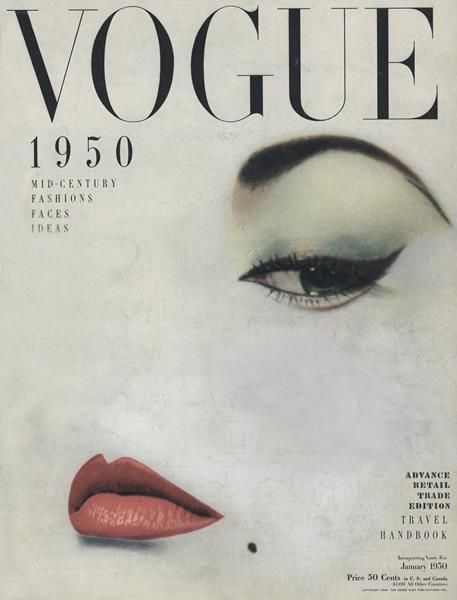
Vogue Magazine, January Edition, 1950.
Magazines are very influential, even subtly, on how one perceives the world, especially today in the modern world. From tabloids labeling women as ‘whales’ to call them fat in the early 2000s, to Seventeen showing young girls and women the newest makeup tips, magazines are all over the place. Young women and girls are especially susceptible to these, as most magazines related to makeup or fashion are advertised to them specifically. However, that is not to say that people of any gender or sexuality can read and enjoy them. If you look at any random magazine from before 1960, the model on the cover is likely a tall, slim, white woman. This will be focused more on the cosmetic aspect and how women used cosmetics to change their apperance to conform to the beauty standard rather than focusing on whihc bodies were deemed best due to the sheer amount of information on both topics.
Even abstract magazine covers, such as the iconic Vogue, January 1950 cover, offer an insight into what was perceived as beautiful. On this cover, there is a striking white background, eyes with blue eyeshadow that hold a mysterious look, bright red, full lips, and a beauty mark by the corner of the lips. It may not be obvious at first what this magazine cover is pushing as beautiful due to its abstract nature, but with a little analysis, it becomes clear. First is the smoky eyes, the half lid. This is reminiscent of the Femme Fatale troupe in movies, especially spy movies. These women are mysterious, tough, and their femininity is essential to their abilities. This suggests that to be mysterious and feminine is considered attractive.
Next is the bright red lips, full and in a small, barely there smile. This adds to the level of mystery associated with the Femme Fatale, but also suggests that fuller lips are more attractive. The color is also striking, bright red against the white background. Red lipstick was very popular in the 1950s. According to Ilise Carter’s book on the topic, this is because during WWII, “the red, almond-shaped mouth…was sex appeal paired with national pride” 2. As we can see, the association with red lips and attractivness was very prominent. It also was a point of pride for women, as it was associated with the red, white, and blue of the American flag. There is also the relationship of the character trope of the Vampire Woman from the 20s that eventually evolved and inspired Marylin Monroe’s apperance and others.
The final piece of the Vogue cover that tells us more about the beauty standards is the stark white background. This is the most on-the-nose part of the whole cover, but is also easy to dismiss. However, pale white skin has long since been something women have strived for across the world, and magazines like this contribute to that. White skin is seen as “so valuable (in South Korea) because it is ingrained into people’s psyche over five or six centuries of thinking about spending time inside [away from the sun], reading a book, studying, and preparing for the national exam is of most prestige,” according to Dr. Gooyoung Kim in an article about the popularity of skin whitening. 3. In some countries, such as South Korea, Japan, India, and more, bleaching agents are used to lighten skin, though this specific article cited is about an antioxident used in South Korea for the same purpose. It is seen as not having to do hard work in the sun, so the skin stays pale, meaning that the person is wealthier. The stark white background is not a coincidence. It is a conscious effort to associate pale skin with wealth, beauty, and attractiveness.
Does the Beauty Standard Only Affect Women?
Women are the main targets for most magazines; this is true. However, the beauty standard affects people of all genders and sexualities. In the 1990s, the emergence of the Club Kids led to a revolution of beauty and fashion. One of the Club Kids who emerged on top and brought queer culture to the mainstream is RuPaul Charles. Charles is best known for his reality competition show, RuPaul’s Drag Race. This show brought Drag into the mainstream, and drag itself began to influence the beauty standard. Drag queens becoming more influential in beauty spaces has also influenced the average American’s own beauty routine. According to Elle Magazine, “former Kardashian makeup artist Joyce Bonelli, who worked with the Kardashians for more than a decade, has said that her “transformational makeup” technique is inspired by “drag anything and everything.” 4.

The Winner of Rupaul’s Drag Race Season 17, Onya Nurve with the Author
This is also significant because for a long time in the late 2010s, the Kardashian family ruled the makeup industry, from Kylie Jenner’s lipkits to average girls and women emulating Kim Kardashian’s average makeup look. For it to be inspired by drag is incredibly important, as it normalizes drag which was once seen as outside of the norm. Later in the Elle article, drag queen and winner of Rupaul’s Drag Race Season 9, Sasha Velour states, “Beauty is so often tied to what’s perceived of as normal, and drag has allowed queer people to be normal in mainstream society.” [^source4]. Drag is very influential, and each winner of RuPaul’s Drag Race tends to go on and do tours and promote their own makeup brands, charities, and other endeavors. This is also important as it gives younger queer people to embrace that side of their identity and inspires them to be their most authentic selves.
But Why is this Important?
While focusing on beauty is seen as frivolous, it does affect how people view the world. By associating whiteness with beauty, minority groups often found themselves trying to emulate whiteness. Black women would straighten their hair with different products. Another popular product amongst minorities was skin bleaching creams. This was largely exacerbated by “colourism, [which is] defined as the stratification by skin tone which almost always privileges light-skinned people of colour over their dark-skinned counterparts, has – and continues to have – significant influence in the economic, educational and social positioning of African Americans, and that historically, skin colour was used as a marker of class and social status within black communities since slavery” 5 Black women were not the only ones who used skin bleaching creams, as these were popular (and in some cases still are) in Asia, as stated previously.
Regardless, it is this idea of needing to change one’s body in order to fit a standard created by society, rather than changing because one wants to that makes the beauty standard important to study and understand. As stated previously, harmful magazine headlines can impact young people of all genders and can led to eating disorders later in life, as experinced by many in the early 2000s. According to research on the topic in the early 2000s, “media exposure predicted disordered eating symptomatology, drive for thinness, body dissatisfaction and ineffectiveness in women, and endorsement of personal thinness and dieting in men.” 6 While this research will not be overly focused on bodies, they are still important to note, as at certain points of time, the shape of ones body determined how attractive they were.
Conclusion
While beauty may be seen as vapid, the beauty standard has a great effect on social mores in our society. In the United States, especially, the beauty standard continues to expand as more people begin to deconstruct what it really means to be beautiful. While eurocentric beauty standards still hold fast, people who fall outside of that small percentage are celebrating their features and enhancing them with makeup. Makeup being used rather than a point of pride and establishing one’s womanhood and now being used to affirm people of all genders is part of this normalization from the beauty standard.
-
https://www.merriam-webster.com/dictionary/beauty ↩
-
Carter, Ilise S. 2021. The Red Menace: How Lipstick Changed the Face of American History. Lanham, Md: Prometheus Books. file:///C:/Users/breev/Downloads/OceanofPDF.com_The_Red_Menace-_Ilise_S_Carter.pdf. ↩
-
Norris, Morgan. 2025. “Popularity of Skin Whitening Sparks Debate in South Korea.” Pulitzer Center. 2025. https://pulitzercenter.org/stories/popularity-skin-whitening-sparks-debate-south-korea. ↩
-
Rodulfo, Kristina. 2018. “Everything We Know about Beauty We Learned from Drag Queens.” ELLE. ELLE. December 11, 2018. https://www.elle.com/beauty/makeup-skin-care/a25426378/drag-influence-beauty-industry/. ↩
-
Baird, M.L. (2021), ‘Making Black More Beautiful’: Black Women and the Cosmetics Industry in the Post-Civil Rights Era. Gender & History, 33: 557-574. https://doi.org/10.1111/1468-0424.12522 ↩
-
Morris, Anne M, and Debra K Katzman. 2003. “The Impact of the Media on Eating Disorders in Children and Adolescents.” Paediatrics & Child Health 8 (5): 287–89. https://doi.org/10.1093/pch/8.5.287. ↩