WWII and Civil Rights
WWII and Civil Rights
The 1940s to the 1970s was a stretch of time that harbored conflict and many different political issues were on the minds of Americans. One of the key issues of this broad stretch of time was segregation, as well as the Second World War. People took very different stances on these issues, and expressed these ideas through music.
The Almanac Singers (1942)
.
About the Artist
The Almanac Singers were formed around 1940. The name of the group came from a letter written to Pete Seeger.1 Many of the members were active in the labor movement, and some were communists, though not all of them, but the positions taken in their music was often aligned with those of the CPUSA.2 Given this, they often performed political music that supported labor unions, civil rights and other issues.
About the Song
This song was released in 1942 as a part of an album by the same name. Overall, the song argues in support of US involvement in World War II, while still leveling some criticism to the US for issues such as Jim Crow. Although it does have some criticism, it is one of few Dear Mr. President songs where this is not the focus of it, with this song instead being supportive.
Initially, the CPUSA advocated nonintervention, as did the Almanac Singers. Earl Browder, leader of CPUSA at the time, said “The fight for a peace policy in the United States today is … to keep the United States from any involvement not only in a military way but from any involvement in economic and political support and sympathy” 3 The Almanac Singers agreed with this stance on nonintervention, even releasing an album titled “Songs for John Doe”, which argued that “the United States government had set upon a program of sacrificing a large number of American lives.” 4
After Germany invaded Russia, the CPUSA’s position flipped towards advocacy for war.5 When this policy shifted, so did the attitudes of the musicians, resulting in the release of the album “Dear Mr. President, and the song in question.6
As the Almanac Singers tended to align with communist ideas, their music can be useful in gauging the focuses of the political left, as well as how the wider public responded to these ideas.
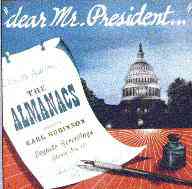
Derived from a digital capture (photo/scan) of the album cover (creator of this digital version is irrelevant as the copyright in all equivalent images is still held by the same party). Copyright held by the record label or the artist. Claimed as fair use regardless. Fair use, https://en.wikipedia.org/w/index.php?curid=19977816.
Happy Fats (1971)
.
About the Artist
Happy Fats, or Leroy Leblanc, was a Cajun musician from Louisiana. He was a member of the popular Rayne-Bo Ramblers, and would often broadcast on KVOL, a radio station in Louisiana.8 He often recorded songs that advocated segregation, such as Dear Mr. President.
About the Song
This source is a song by Leroy Leblanc, which is intended to be an argument against integration. It assumes its audience is white and anti-integration, as it appeals to such sensibilities as a primary argument, presenting the idea of integration as an absurd overreach by the government.
Government overreach is a common theme in music of this type, as an extension of presenting Civil Rights leaders as troublemakers, in the case of these songs, specifically through enacting polices and laws.9 “The federal government is depicted as the primary threat to the traditional Southern lifestyle, rather than African-Americans who will not ‘stay in their place’”9
Happy Fats takes a right wing position on the discussion around integration, and presents it in a way that is less explicit than some older music of this type, according to Michael Wade.10 This represents a shift in attitudes around this kind of racism, as seen by the way that expressions of these ideas became more subtle in the face of this cultural shift.
“In a relatively short time, however, the traditional lexicon of white racism became largely unacceptable as a form of public expression, especially in politics. The segregationists would have to find new political allies, and a new vocabulary with which to express largely unchanged beliefs. Some of the newly tailored concepts were locally available in the lyrics of Johnny Rebel, Son of Mississippi, Happy Fats, and the mysterious James Crow. At least part of their message, then, suggests a transition toward the more subtle, coded appeals which were increasingly the stuff of politics” 10
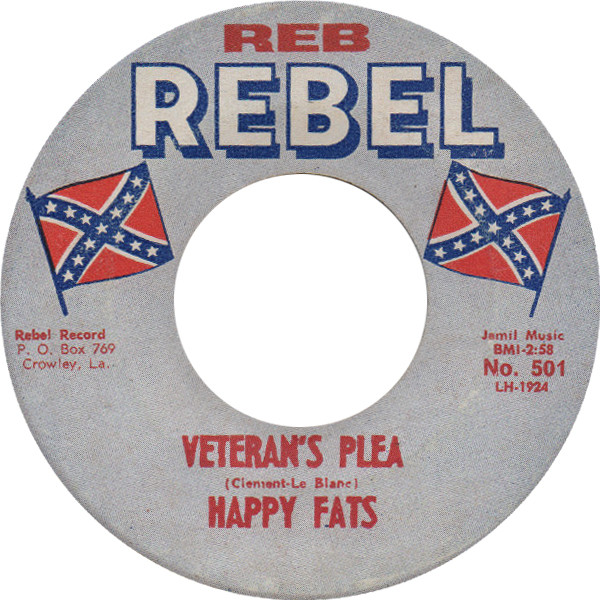
Happy Fats. “Dear Mr. President.” Reb Rebel, 1971.
Comparison
These two songs take on very different perspectives when it comes to racial issues, for one. The Almanac Singers, being associated with the CPUSA, tended towards advocacy of civil rights, as this was in alignment with its position.11 Happy Fats, however, takes a staunchly segregationist position in much of his music. This reflects the ways that divisions about race in America in this era. Additionally, the Almanac singers positions on US involvement in World War II reveals the complicated dynamics of the political far left in America and Russia.
The direct topics of each song are notably very different from each other, focusing their attention on different issues. The attitude towards the president in each song is also quite different as well. This establishes that songs using this structure can be very diverse in terms of subject matter, tone, and perspective, and as such will not be able to reveal the full array of public discussion on any one subject, but instead can reveal one perspective, and by looking at how it was received, make inferences about larger cultural moods.
-
R. Serge Denisoff. “‘Take It Easy, but Take It’: The Almanac Singers.” The Journal of American Folklore 83, no. 327 (1970): 23. ↩
-
R. Serge Denisoff. “‘Take It Easy, but Take It’: The Almanac Singers.” The Journal of American Folklore 83, no. 327 (1970): 31. ↩
-
Joel Seidman. “Labor Policy of the Communist Party during World War II.” ILR Review 4, no. 1 (1950): 56-57. ↩
-
R. Serge Denisoff. “‘Take It Easy, but Take It’: The Almanac Singers.” The Journal of American Folklore 83, no. 327 (1970): 25. ↩
-
Joel Seidman. “Labor Policy of the Communist Party during World War II.” ILR Review 4, no. 1 (1950): 59. ↩
-
R. Serge Denisoff. “‘Take It Easy, but Take It’: The Almanac Singers.” The Journal of American Folklore 83, no. 327 (1970): 27 ↩
-
R. Serge Denisoff. “‘Take It Easy, but Take It’: The Almanac Singers.” The Journal of American Folklore 83, no. 327 (1970): 26-27. ↩
-
The Country Music Hall of Fame and Museum. The Encyclopedia of Country Music. Oxford University Press, 1998. EBSCOhost: 227. ↩ ↩2
-
Beth A. Messner, Art Jipson, Paul J. Becker, and Bryan Byers. , “The Hardest Hate: A Sociological Analysis of Country Hate Music,” Popular Music and Society 30, no. 4 (2007): 513-531. ↩ ↩2
-
Michael Wade. , “Johnny Rebel and the Cajun Roots of Right-Wing Rock: [1],” Popular Music and Society 30, no. 4 (2007): 493-512,574. ↩ ↩2
-
Clarence Taylor. “RACE, CLASS, AND POLICE BRUTALITY IN NEW YORK CITY: THE ROLE OF THE COMMUNIST PARTY IN THE EARLY COLD WAR YEARS.” The Journal of African American History 98, no. 2 (2013): 205–28. ↩