The Craft Brewing Movement
Fermentrepreneurialism
Identifying changes in consumer demand and adapting quickly to cater to them is inherently entrepreneurial. The localized nature of the craft industry meant that vast localities began to become viable spaces to start a brewery.
Shifting Tastes
Shifting tastes under neoliberalism were not a random cultural shift, and the erosion of the post-war “mass-consumption” economy introduced new demands for individualism rather than the sameness that standardized and mass consumption suggested. The Craft Beer Movement is part of a broader taste revolution within the United States, then. The rejection of homogenized products relates to a new American cultural identity in which authenticity, quality, and expertise were emphasized.
In 1979, the Washington Post acknowledged the viability of alternative brewing and the emerging industry. “Many people feel that American Beer, like the proverbial apple pie, is not what it used to be, that it has become standardized to the lowest common denominator.” 1
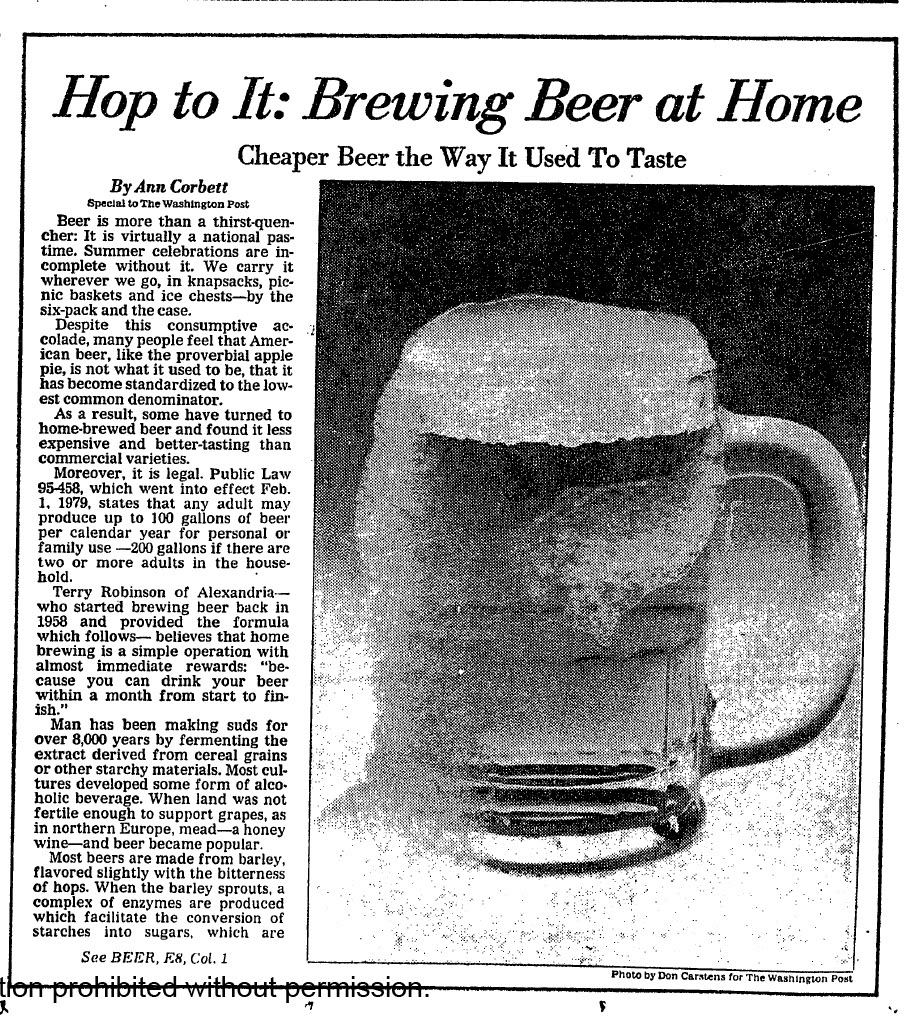
Instead of safeguarding his brewing secrets, Terry Robinson shared his recipe with the Washington Post, revealing a critical aspect of the Craft Beer Movement: the democratization of brewing knowledge.
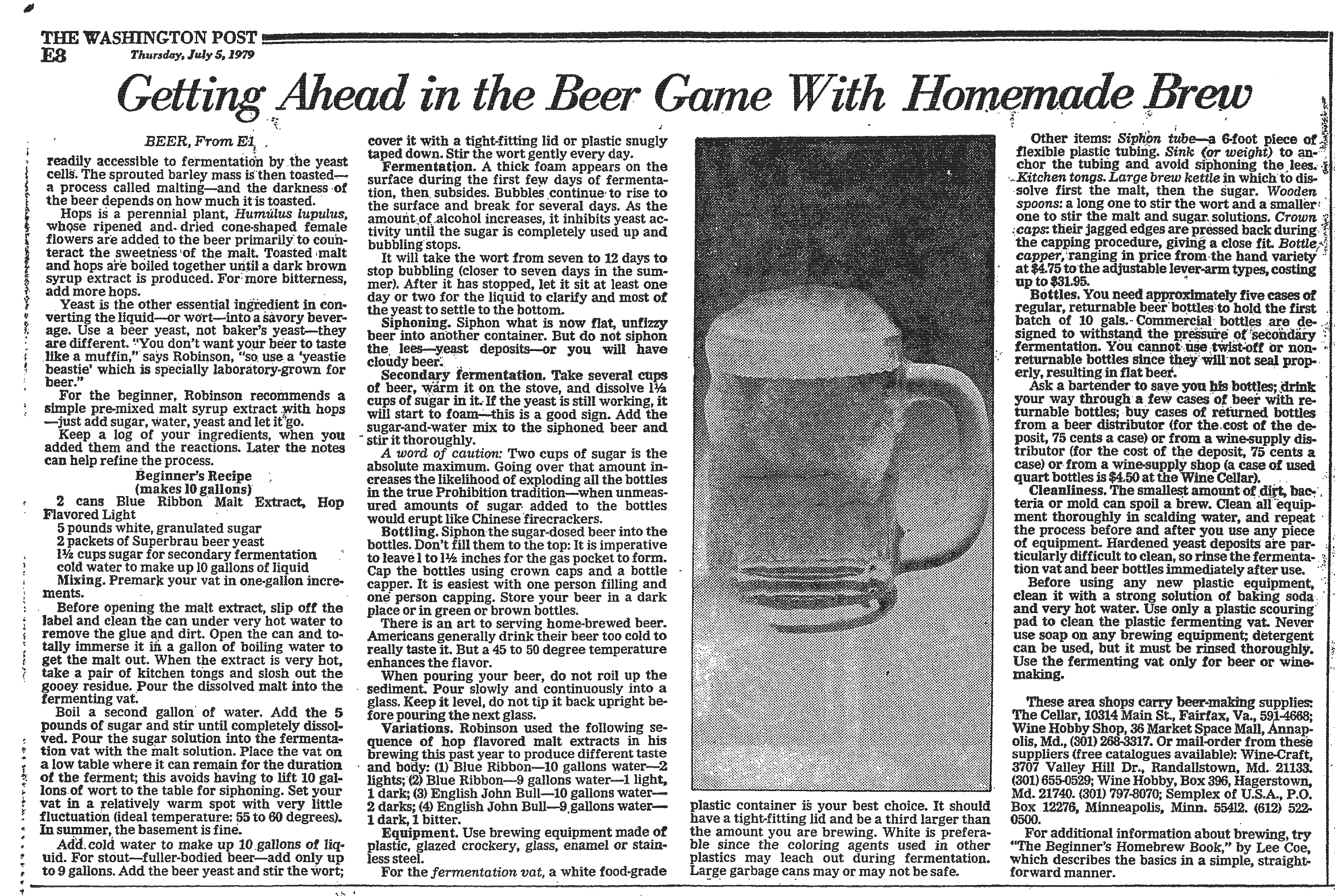
By Ann CorbettSpecial to The,Washington Post. (1979, Jul 05). Hop to it: Brewing beer at home: Cheaper beer the way it used to taste getting ahead in the beer game with homemade brew. The Washington Post (1974-) Retrieved from https://libproxy.unm.edu/login?url=https://www.proquest.com/newspapers/hop-brewing-beer-at-home/docview/147056600/se-2
DeReindustrializing
The Bates Bill that legalized homebrewing, serving craft beer to customers and deregulated the craft brewing industry in California is not merely signifcant for validating a hobbyist to entrepreneurial pipeline, put is part of a trend of broader shifts that fundamentally altered the social and economic fabric of American society.
The epochal shift toward neoliberalism - a web of related policies that, broadly speaking, reduced the footprint of government in society and reassigned economic power to private market forces - that began in the United States and Great Britain in the late 1970s fundamentally changed [even] the world.” 2 The Homebrewing Movement and Craft Beer Revolution provide valuable analytical leverage. For example, the industrial characteristics that modern breweries have widely embodied by adopting deserted spaces such as warehouses, fabrication shops, and mechanical workshops find roots in deindustrialization. As Wesley Shumar and Tyson Mitman explain in “Producing and Consuming the Craft Beer Movement,” neoliberal pressures for financial deregulation, the elimination of the gold standard, and the restructuring of labor-capital relationships:
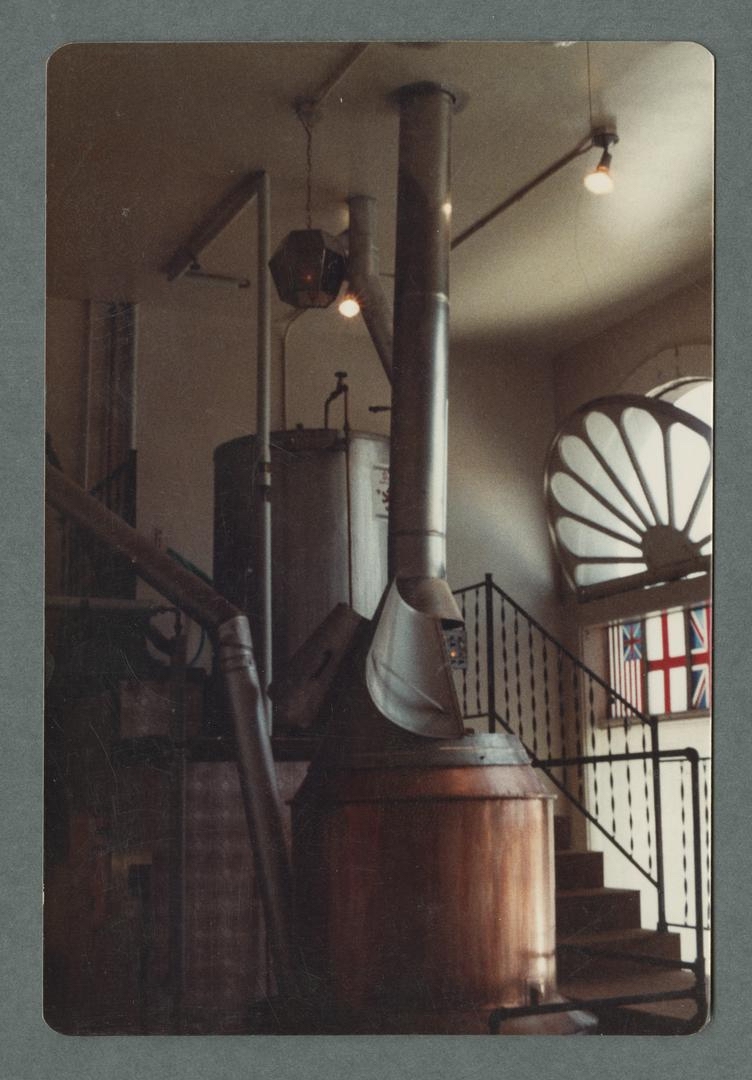
Oregon Hops & Brewing Archives, Oregon State University. Grant’s Brewery Equipment. Oregon Digital. Accessed 2026-05-13. https://oregondigital.org/concern/images/fx71bd48j
These inexpensive, although dilapidated spaces were well-suited for the hospitality, artisanal, and service industry, particularly wineries and breweries, which necessitated large and sterile spaces to accommodate large vats, grain mills, and fermenters.
The repurposing of large post-industrial spaces exemplifies the transition from standardization to experimentation. “Today, the word “neoliberal” is often used to condemn a broad swath of policies, from prizing free market principles over people to advancing privatization programs,” but in some regards, the “reindustrialized” nature of the brewing industry may be regarded as neoliberal, or at least a side effect. 1
-
Gary Gerstle, The Rise and Fall of the Neoliberal Order: America and the World in the Free Market Era (New York, Ny: Oxford University Press, 2022). ↩
Apostacy
By the turn of the 1990s, though, the Craft Brewing industry was undergoing a shift. While attorney turned brewing equipment supplier, Thomas M Burns Jr., explains the industry had retained its “certain charm, a romantic quality, a fraternal element,” his experience also reveals a shift further toward the commodification of the industry in 1988. “Initially, brewers were hobbyists trying to make a living with their hobby. Now we are seeing a greater level of professionalism.” 4 What began as an alternative to standardized beer and began as a counterculture movement started to become further integrated into mainstream capitalist markets. At the same conference Burns was interviewed, contract brewer, Francis W. Cattani further revealed the shift from an artisanal, local, and anti-corporate nature to a corporatized one: “My purpose is sales. I can take this idea and make it blossom,” he explained.5 By the 1990s, the Craft Brewing Industry was enduring a critical shift toward commodification and competition that transcended Bill Owens’ quest to merely be the first “true” brewery.
Conclusion
Homebrewers and localists were contributing to the character of the Craft Beer Revolution long before the catalyzing Bates Bill. While the bill itself and its deregulatory nature may be situated within broader neoliberal trends, craft brewers retained their cultural identity as hobbyists, collaborators, and innovators for the better part of a decade before the commercialization of the industry complicated the Craft Beer Movement’s narrative.
“As bigger businesses… [breweries] became beholden to finance, mergers, take overs, etc.” 6 Market competition, investment obligations, and buyouts have undermined the Craft Beer Momvement’s initial tenets, and the struggle between market logics and authenticity have defined the brewery landscape well into the 21st century.
-
Ann CorbettSpecial to The,Washington Post. (1979, Jul 05). Hop to it: Brewing beer at home: Cheaper beer the way it used to taste getting ahead in the beer game with homemade brew. The Washington Post (1974-) Retrieved from https://libproxy.unm.edu/login?url=https://www.proquest.com/newspapers/hop-brewing-beer-at-home/docview/147056600/se-2” ↩
-
Gary Gerstle, The Rise and Fall of the Neoliberal Order: America and the World in the Free Market Era (New York, Ny: Oxford University Press, 2022). ↩
-
Shumar, Wesley, and Tyson Mitman. Producing and Consuming the Craft Beer Movement. Taylor & Francis, 2023, 54. ↩
-
Thomas M. Burns, Jr., Interview by Dennis Ray Wheaton at the Fifth Annual National Microbrewers Conference, Chicago. September, 1988, 3. https://gsb-faculty.stanford.edu/glenn-r-carroll/files/2022/04/drw_craft_beer_interviews_1988_v3.pdf. ↩
-
Francis W. Cattani, Interview by Dennis Ray Wheaton at the Fifth Annual National Microbrewers Conference, Chicago. September, 1988, 3. https://gsb-faculty.stanford.edu/glenn-r-carroll/files/2022/04/drw_craft_beer_interviews_1988_v3.pdf. ↩
-
Shumar, Wesley, and Tyson Mitman. Producing and Consuming the Craft Beer Movement. Taylor & Francis, 2023, 5. ↩