The Middle East in American Media: How Western Portayal Created a Cultural Enemy
Islamophobia in the 21st Century
Cultural Division after September 11th
Fear underscored the American transition into the new millenium, with whispers of a technological crisis opening the first seconds of 2000. Unfortunately, this unrest was not settled for long.
In September of 2001, the Al Qaeda attacks on the World Trade Center and the Anthrax crisis created a frenzy among the American public. This chaos led to a broad unification of American thought, which quickly positioned against the most relevant target- the Middle East.1 Despite the growth of anti-Islam sentiment throughout the 21st century, this event was still the single worst moment in terms of American relations with the Middle East, laying the groundwork for both war in various Asian nations and a sharp rise in hate crime against Americans who belonged to Islam or Islam-adjacent religions (such as Sikhs, who received cultural subjugation due to clothing and prayer rituals that resembled those that Muslims might partake in).
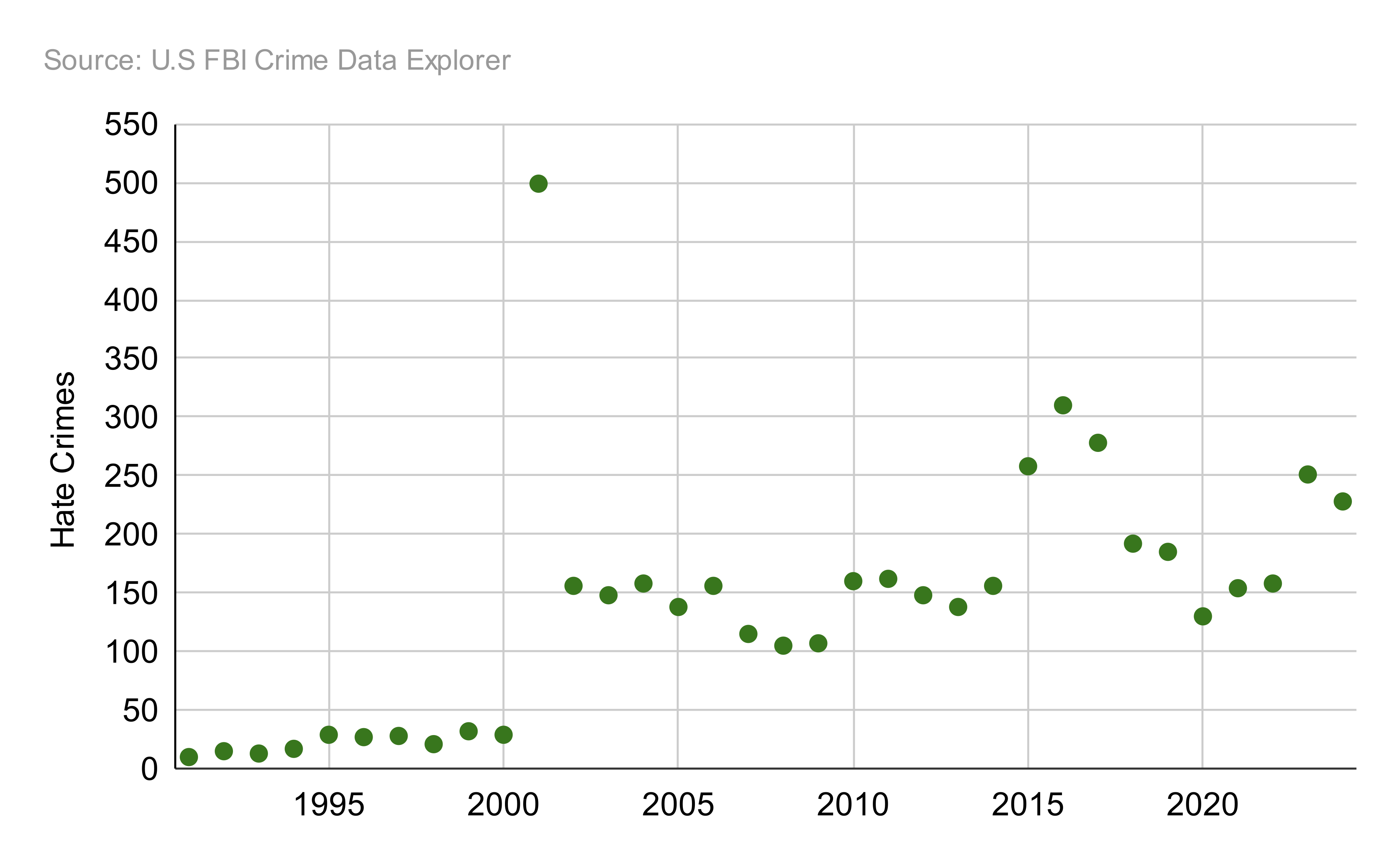
The terror attacks of September 11th caused a significant uptick in hate crimes concerning race and religion.
Islam as a Nationality
Over time, the American conception of the Middle East stopped being defined by clear regional borders, with many beginning to understand the region as being comprised of miscellaneous Islamic nations2. Because of this, the practice of Islam was treated like an ethnic trait, allowing many prejudiced individuals in the west to disavow members of the entire region. If Islam is simply a religion, then it is unamerican to squash their pursuit of free religion under the constitution. If Islam is a nationality, you can write off every Muslim as a foreign national intent on destroying the nation.
This belief is not exclusive to practitioners of Islam (in fact, narratives about foreign invaders apply to a wide range of ethnic minorities) but it has a uniquely prominent space in the American ethos, especially after the terrorist attacks of 9/11 seemed to justify the xenophobic beliefs of certain U.S. citizens.
A Cultural Enemy in Film and Beyond
American Sniper3 is a film depicting the military experience of Chris Kyle, a Navy S.E.A.L sniper during the Iraq war. This film (in contrast with the other three films) demonstrates how strongly the American media believed in their right to occupy the Middle East. While the movie is not exactly pro-war, it focuses so heavily on the plight of one particular soldier and fails to truly address any evils that may have been committed by him or his compatriots.
Violence against both Middle Eastern combatants and civilians is such a constant in western media that a film primarily focused on the consequences of war seems to be completely uninterested in addressing the consequences for the other side. To the broad American public, a veteran with PTSD is the deepest tragedy imaginable, and this movie reflects that particular ache. Despite the horrors of war affecting people on both sides (including that veteran), the overweight focus on a singular American soldier’s mental struggles seems to be indicative of a culture that has separated Middle Easterners and practicioners of Islam from their humanity.
To see a portrayal of a man killing hundreds of people (even as the tool of a government that he does not have control over) and have your immediate concern be his sanity is extremely dissonant with claimed American ideals, including the freedom to life and pursuit of happiness. This viewpoint, which has developed for nearly a century, has plagued the general western public, only growing deeper after the events of 9/11. American media at all levels has conditioned the average citizen to approach the Middle East and its people with not only caution, but with active prejudice.
-
Mishra, Smeeta. 2006. “Islam and Democracy: An Analysis of Representations in the United States Prestige Press from 1985–2005.” Order No. 3263370, The University of Texas at Austin. ↩
-
Mokdad, Linda Y. “Imaginary Geography: Mapping the History of the Middle East in Post-9/11 American Cinema.” Order No. 3711124, The University of Iowa, 2013. ↩
-
Eastwood, Clint, dir. 2014. American Sniper. Film. United States of America: Warner Brothers. ↩